Modern Spanish did not simply emerge from Latin fully formed. Like English, it was built in layers.
Roman soldiers and settlers brought Latin to the Iberian Peninsula. Germanic kingdoms came and went. Arabic-speaking Muslims ruled parts of Iberia for centuries and left thousands of words behind. Medieval kings elevated one regional dialect above its rivals. Grammarians tried to impose order on the written language. Then conquest and colonization carried Spanish across an ocean, where Indigenous and African languages began changing it all over again.
The result is a language that is unmistakably descended from Latin but carries traces of almost everyone it encountered along the way.
Spanish also took a very different path from English when it came to spelling. English gradually accumulated silent letters, historical spellings, and borrowed words whose pronunciation often has to be learned individually. Spanish developed a much more regular relationship between sound and writing.
And that is where the accent marks enter the story.
The á, é, í, ó, and ú of modern Spanish are not decorative relics left over from some earlier language. They belong to a working system. In most words, Spanish spelling already tells you which syllable to stress. When a word breaks the expected pattern, the acute accent tells you so. The same mark can also separate words that would otherwise look identical: tú means “you,” while tu means “your.”
Spanish did not begin with this tidy system.
It had to develop one.
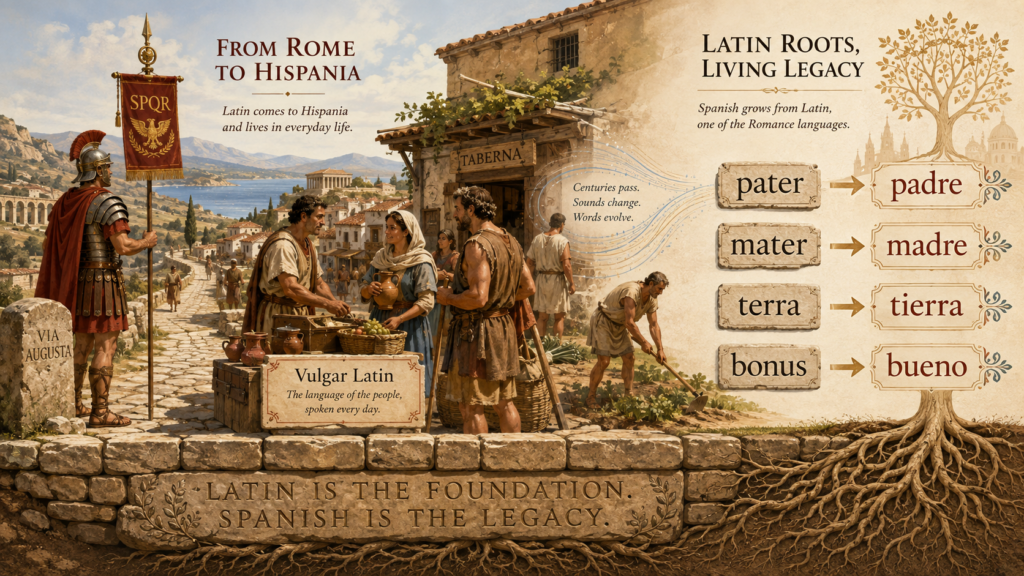
1. Latin roots (218 BC–5th century AD)
The story begins with Rome.
Roman forces arrived on the Iberian Peninsula in 218 BC during the Second Punic War (between Rome and Carthage). Conquest took generations, but eventually most of the peninsula became part of the Roman world.
Latin came with it.
Not, for the most part, the polished Latin of Cicero and Virgil. Soldiers, merchants, farmers, administrators, and settlers spoke the changing everyday varieties that linguists conventionally call Vulgar Latin.
That distinction matters.
Languages are usually transformed in streets, homes, markets, barracks, and fields long before grammarians write down what has happened. The Latin spoken by ordinary people continued to change from one generation to the next. Pronunciations shifted. Endings disappeared. New words appeared. Different regions developed different habits.
Eventually, people in Spain were no longer speaking Latin in quite the same way as people in Gaul, Italy, or the Balkans.
Given enough time, those differences became languages.
Spanish, Portuguese, French, Italian, Romanian, Catalan, and the other Romance languages are therefore not languages that merely borrowed heavily from Latin. They are descendants of Latin.
That is why so much of basic Spanish still reveals its ancestry:
Latin pater became Spanish padre.
Latin mater became madre.
Latin terra became tierra.
Latin bonus gave Spanish bueno.
The changes were substantial, but the family resemblance remained.
Spanish grammar is Latin at its foundation too. Its masculine and feminine nouns, verb conjugations, much of its sentence structure, and an enormous share of its everyday vocabulary descend from the language Rome brought to Hispania.
This is the bedrock.
Everything that came later was built on top of it.
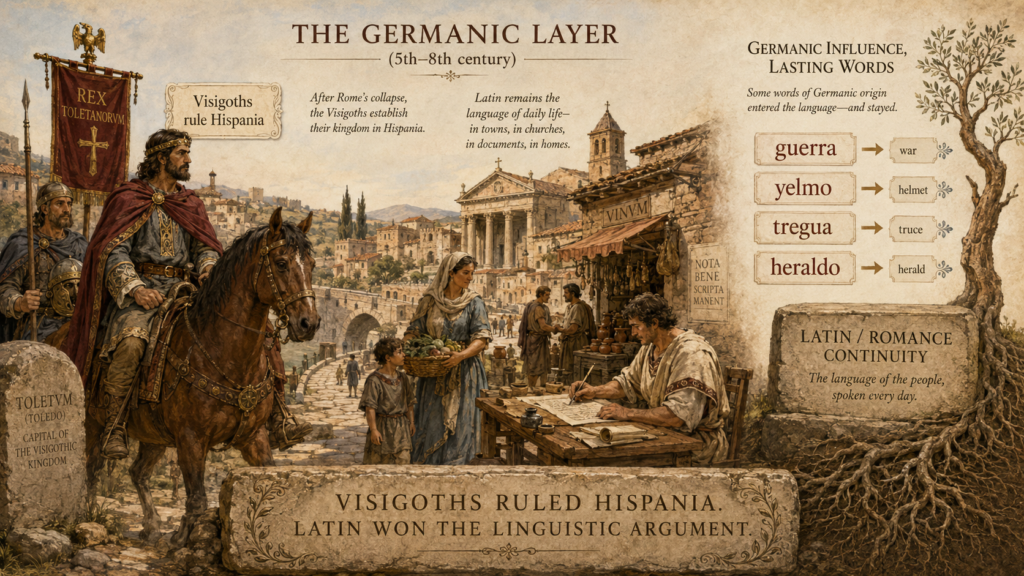
2. The Germanic layer (5th–8th century)
Then Rome collapsed.
As imperial control weakened in western Europe, Germanic peoples moved into former Roman territory. In Iberia, the Visigoths eventually established the dominant kingdom and ruled much of the peninsula from the fifth century until the early eighth.
This might sound like the beginning of an entirely new language.
It wasn’t.
The Visigoths conquered Romanized people, but they did not replace their language. Instead, the conquerors themselves gradually adopted the Latin spoken around them.
That makes the Visigothic episode very different from the Norman conquest of England. Norman French would pour thousands of words into English and help create a lasting division between everyday Germanic vocabulary and more prestigious French and Latin vocabulary.
Nothing comparable happened in Spanish.
Germanic influence was real, but relatively modest. Some Germanic vocabulary had already entered late Latin before the Visigoths established themselves in Iberia, and only a small number of Spanish words can confidently be traced to direct Gothic borrowing. Military and social vocabulary such as guerra (“war”), yelmo (“helmet”), tregua (“truce”), and heraldo (“herald”) preserves part of that broader Germanic layer.
Germanic personal names also survived remarkably well. Names of Germanic origin became common among medieval Iberian elites and eventually filtered into the wider population.
But the language underneath remained Romance.
The Visigoths ruled Hispania.
Latin won the linguistic argument.
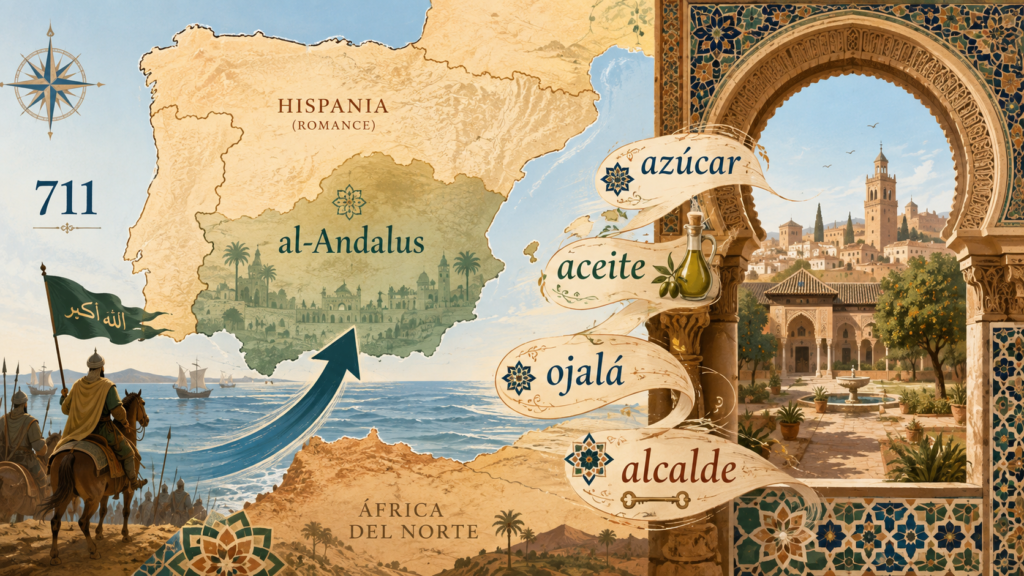
3. The Arabic pivot (711–1492)
Then came 711.
Muslim forces crossed from North Africa into Iberia and defeated the Visigothic kingdom with astonishing speed. Within a few years, much of the peninsula had fallen under Muslim control.
The territory known as al-Andalus would change constantly over the centuries that followed. Kingdoms divided, reunited, expanded, and contracted. Christian states survived in the north and gradually pushed southward.
But Arabic now had a permanent place in the linguistic history of Spain.
And it stayed there for centuries.
Arabic was used in government, scholarship, commerce, science, agriculture, architecture, and daily life across large parts of Muslim Iberia. Arabic speakers, Romance speakers, Berber speakers, Jews, Christians, and Muslims lived in complicated patterns of contact that shifted from region to region and century to century.
Languages notice that sort of thing.
Spanish eventually absorbed more than 3,000 words of Arabic origin, while its underlying grammar remained overwhelmingly Latin.
You can still see the evidence everywhere.
aceite — oil
acequia — irrigation ditch
alcalde — mayor
alcázar — fortress or palace
alfombra — carpet
algodón — cotton
álgebra — algebra
almohada — pillow
azúcar — sugar
naranja — orange
Many reveal their ancestry before you even know what they mean.
The beginning al- is often a clue because al was the Arabic definite article—the equivalent of English the. When Spanish speakers borrowed a word, they frequently borrowed the article along with it. What had been two pieces in Arabic became one Spanish word.
An acequia, an alberca, and an alcázar therefore carry tiny pieces of medieval Arabic inside modern Spanish.
The borrowing also tells us something about history.
Languages tend to borrow words for things their speakers encounter through other people. The abundance of Arabic vocabulary connected with irrigation, mathematics, agriculture, architecture, commerce, administration, food, and household life is not random. It reflects the areas in which Arabic-speaking culture left a particularly strong mark on medieval Iberia.
But Arabic did not transform Spanish in quite the way French transformed English.
English often kept both words: the Germanic ask and the French-derived inquire, for example, or cow and beef.
Spanish generally did not develop the same enormous everyday/formal double vocabulary from Arabic. Arabic words were more likely to fill a need, compete with another word, or simply become the ordinary Spanish word for the thing itself.
The influence was vast.
But Spanish remained a Romance language.
4. Castile rises (13th–15th century)
There was not yet one language called “Spanish” spoken uniformly across medieval Iberia.
The peninsula contained several Romance varieties. Galician-Portuguese flourished in the west. Catalan developed in the east. Other varieties included Leonese, Aragonese, and the Romance dialects associated with Muslim-controlled territories.
Castilian was one among them.
Then Castile became powerful.
As the Christian kingdoms expanded southward during the long process traditionally called the Reconquista, Castilian traveled with settlers, soldiers, administrators, clergy, and royal officials.
Political expansion gave a regional dialect geographic reach.
Government gave it prestige.
King Alfonso X of Castile, who reigned from 1252 to 1284 and became known as Alfonso the Wise, played an especially important role. His court sponsored works on history, law, astronomy, science, and literature, and Castilian increasingly served as a language in which serious knowledge could be written rather than merely spoken.
That was important.
Latin still carried enormous scholarly prestige. Using Castilian for law, history, and learning demonstrated that the vernacular could do work once reserved for Latin.
A dialect was becoming a literary and administrative language.
And then came one extraordinary year.
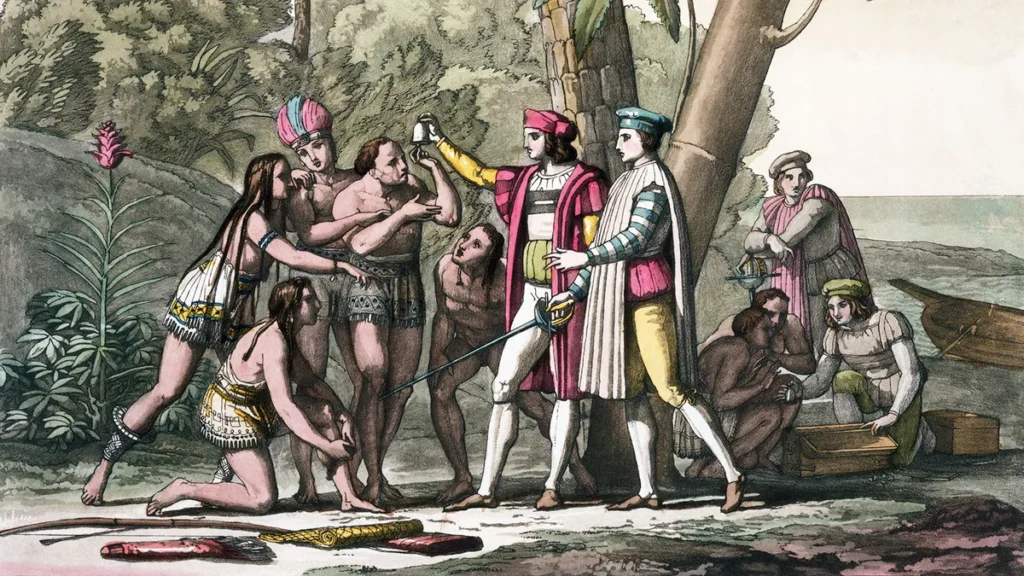
5. 1492: conquest, Columbus, and a grammar
The year 1492 is famous for one event.
For the history of Spanish, it deserves to be famous for three.
In January, the Catholic Monarchs Ferdinand and Isabella captured Granada, ending the last Muslim-ruled kingdom in Iberia.
In August, Christopher Columbus sailed west under the Spanish crown.
And that same year, the scholar Antonio de Nebrija published his Gramática de la lengua castellana — the first grammar devoted to a Romance language.
The timing is almost too perfect.
Nebrija was doing something unusual. Grammars were traditionally written for prestigious classical languages such as Latin and Greek. Castilian was something people simply spoke.
Nebrija treated it as a language worthy of systematic description.
More than that, he understood language and political power as connected. In his famous formulation, language had always been a “companion of empire.” He anticipated that Castilian would travel with Spanish power and that people brought under that power would need to learn it.
He could not have known just how far it was about to travel.
Within decades, Spanish ships, soldiers, missionaries, administrators, merchants, and settlers were carrying Castilian across the Atlantic.
Spanish had acquired a grammar just as it was about to become a world language.
6. A language learns to spell itself
But writing Spanish still presented a problem.
Languages change naturally. Spellings do not always keep up.
Medieval Spanish writers varied considerably in how they represented sounds. Several letters could compete for the same sound. Pronunciations shifted. Old distinctions disappeared while new ones emerged.
So writers and printers gradually faced the same question that confronted other European languages:
How should this language actually be spelled?
Nebrija had already argued for a close relationship between sound and writing. Later grammarians and printers continued wrestling with the problem.
Spanish eventually moved toward an unusually phonological spelling system: not perfectly “write it exactly as you hear it,” but much closer to that ideal than English.
That is why a Spanish speaker who encounters an unfamiliar written word can usually make a good attempt at pronouncing it.
An English speaker cannot say the same.
Consider though, through, cough, rough, and bough.
Spanish never accumulated quite that level of chaos.
But predictable letters were only part of the solution. Spanish also needed a way to show stress.
Every Spanish word has a stressed syllable:
CA-sa
ha-BLAR
te-LÉ-fo-no
Spanish eventually developed rules that allow the spelling itself to predict the stress in most words. Words ending in a vowel, n, or s normally receive stress on the next-to-last syllable. Most words ending in another consonant normally receive stress on the last.
Only when a word behaves differently does the written accent usually need to step in.
canción
música
inglés
rápido
The acute accent is therefore not merely a pronunciation symbol pasted onto certain vowels.
It is part of a system.
The reader learns the default rule. The accent appears when the word needs to tell you, “Not this time.”
7. The Royal Spanish Academy and the rules take shape (1713–present)
By the early eighteenth century, Spanish was spoken across an enormous territory.
That created a new problem.
How do you maintain a shared written language when millions of speakers are separated by oceans?
Spain founded the Real Academia Española, or Royal Spanish Academy, in 1713. Its famous traditional motto became “Limpia, fija y da esplendor”—roughly, “It cleans, fixes, and gives splendor.” The Academy’s first great undertaking was its Diccionario de autoridades, published in six volumes between 1726 and 1739.
English never developed an institution with comparable authority.
But it would be misleading to imagine that the Academy sat down in 1713 and invented modern Spanish spelling.
The process was much slower.
Spanish orthographers had been debating spelling for centuries. The Academy inherited that tradition and gradually regularized it. Rules for written stress were refined over generations; the recognizable modern system of agudas, llanas, and esdrújulas did not emerge all at once. Academic rules continued changing well into the nineteenth and twentieth centuries.
Eventually, however, Spanish arrived at something English never really achieved: a broadly shared spelling system that tells readers a great deal about pronunciation.
The accent mark does several jobs within it.
It tells us when normal stress rules have been broken:
canción
fácil
médico
It can show that two adjacent vowels belong to different syllables:
país
María
río
And it can distinguish otherwise identical words:
tu — your
tú — you
el — the
él — he
si — if
sí — yes
The mark is tiny.
Its workload is not.
And unlike the accent in an English word such as café, which can sometimes disappear without making the rest of English spelling collapse, Spanish accents belong to the machinery of the language.
8. Spanish crosses the Atlantic (1500s onward)
Meanwhile, Spanish was becoming much larger than Spain.
Colonization carried the language throughout much of the Americas and into parts of Africa and Asia. But just as English changed when it left Britain, Spanish changed when it left Iberia.
It encountered hundreds of languages that had names for animals, plants, foods, landscapes, objects, and cultural practices Europeans had never encountered.
Spanish borrowed.
From Taíno, spoken in the Caribbean, came words that eventually produced Spanish huracán and hamaca.
From Nahuatl, the language of the Aztec world, came chocolate, tomate, and aguacate.
From Quechua came words such as puma, cóndor, and papa in much of South America.
Some of those words did not stop with Spanish.
Spanish carried them into other European languages.
English speakers say chocolate, tomato, hurricane, avocado, puma, and condor partly because Spanish served as the bridge between Europe and the languages of the Americas.
The borrowing went both ways.
And pronunciation changed too.
A speaker in Madrid does not sound like a speaker in Mexico City. Neither sounds exactly like a speaker in Buenos Aires, Havana, Bogotá, San Juan, or Seville. Words differ. Pronouns differ. Verb forms differ. Sounds differ.
In much of Spain, c before e or i and z are pronounced differently from s. Across most of Latin America, they are pronounced alike.
In Argentina and Uruguay, ll and y may have a sound that immediately identifies the Río de la Plata region.
Across large parts of Latin America, ustedes replaced vosotros as the ordinary plural form of “you.” In other regions, vos competes with or replaces tú.
There is no single Spanish accent.
There never was.
9. One language, many Spanishes
That leaves modern Spanish in an interesting position.
It is one of the world’s great international languages, spoken across countries separated by thousands of miles. Its speakers have distinctive accents, slang, vocabulary, and sometimes grammar.
Yet a newspaper published in Madrid can be read in Mexico City. A novel from Colombia can be read in Argentina. A student in Peru and a student in Spain learn essentially the same spelling rules.
Variation survives alongside remarkable written unity.
Today, the Royal Spanish Academy works with the other national academies of Spanish through the Association of Academies of the Spanish Language, reflecting an important change in perspective: standard Spanish is no longer treated simply as the language of Spain exported to everyone else. The modern academic project is explicitly panhispanic, involving the Spanish-speaking world as a whole.
That seems appropriate.
Spain gave the language its name and much of its early written tradition. But modern Spanish belongs just as much to Mexico, Colombia, Argentina, Peru, the Caribbean, Central America, the United States, and hundreds of millions of speakers elsewhere.
And all those speakers inherited the layers beneath it.
Roman soldiers supplied the foundation.
Germanic kingdoms left a light imprint.
Centuries of Arabic contact transformed the vocabulary.
Castile supplied the dialect that became dominant.
Nebrija gave that language its first grammar just as Spanish power was carrying it overseas.
The Americas gave Spanish thousands of new speakers, new words, and new ways of speaking.
And generations of writers, printers, grammarians, teachers, and academies gradually turned Spanish spelling into one of its most useful features: a system in which the written word usually tells you how it wants to be spoken.
That brings us back to the accent mark.
The little stroke over á, é, í, ó, or ú may look like a minor piece of punctuation.
It is really the visible end of a much longer story.
A story that began with Latin, passed through medieval kingdoms and an empire, crossed an ocean, and is still being written by more than half a billion Spanish speakers today.