Typing accent marks on Windows doesn’t have to be complicated. Alt codes provide a quick way to insert accented characters without switching keyboard layouts or hunting through character maps. In a compatible Windows application, hold the Alt key and enter the complete four-digit code on the numeric keypad with Num Lock turned on.
This guide focuses on common Western European characters that can be entered with traditional Windows Alt codes. It is not a complete list of every accented Unicode character.
For other platforms, see our guides for typing accents on Mac, iPhone and iPad, or Chromebooks.
How to Use Alt Codes on Windows
Using Alt codes is straightforward once you know the method:
- Make sure Num Lock is on – Your number pad must be active
- Hold down the Alt key – Keep it pressed throughout
- Type the complete four-digit code, including the leading zero – Use only the number pad on the right side of your keyboard (not the numbers at the top)
- Release the Alt key – Your accented character appears
Important note: Traditional Alt codes require a numeric keypad. Some laptops have an embedded numeric keypad marked on certain letter keys, but the activation method varies by manufacturer. If your computer has no numeric keypad, use one of the alternative methods described below.
Takes 10 seconds. No spam.
Common Spanish Accent Alt Codes
Spanish uses acute accents on five vowels, along with ñ, the diaeresis in ü, and the inverted punctuation marks ¿ and ¡. These are among the most frequently searched Alt codes.
| Character | Alt Code | Description |
|---|---|---|
| á | Alt + 0225 | Lowercase a with acute accent |
| é | Alt + 0233 | Lowercase e with acute accent |
| í | Alt + 0237 | Lowercase i with acute accent |
| ó | Alt + 0243 | Lowercase o with acute accent |
| ú | Alt + 0250 | Lowercase u with acute accent |
| Á | Alt + 0193 | Uppercase A with acute accent |
| É | Alt + 0201 | Uppercase E with acute accent |
| Í | Alt + 0205 | Uppercase I with acute accent |
| Ó | Alt + 0211 | Uppercase O with acute accent |
| Ú | Alt + 0218 | Uppercase U with acute accent |
| ñ | Alt + 0241 | Lowercase n with tilde |
| Ñ | Alt + 0209 | Uppercase N with tilde |
| ü | Alt + 0252 | Lowercase u with diaeresis (called an umlaut in German) |
| Ü | Alt + 0220 | Uppercase U with diaeresis (called an umlaut in German) |
| ¿ | Alt + 0191 | Inverted question mark |
| ¡ | Alt + 0161 | Inverted exclamation mark |
French Accent Alt Codes
French uses acute, grave and circumflex accents, along with the cedilla, the diaeresis (tréma) and the ligatures œ and æ.
| Character | Alt Code | Description |
|---|---|---|
| à | Alt + 0224 | Lowercase a with grave accent |
| è | Alt + 0232 | Lowercase e with grave accent |
| ù | Alt + 0249 | Lowercase u with grave accent |
| À | Alt + 0192 | Uppercase A with grave accent |
| È | Alt + 0200 | Uppercase E with grave accent |
| Ù | Alt + 0217 | Uppercase U with grave accent |
| â | Alt + 0226 | Lowercase a with circumflex |
| ê | Alt + 0234 | Lowercase e with circumflex |
| î | Alt + 0238 | Lowercase i with circumflex |
| ô | Alt + 0244 | Lowercase o with circumflex |
| û | Alt + 0251 | Lowercase u with circumflex |
| Â | Alt + 0194 | Uppercase A with circumflex |
| Ê | Alt + 0202 | Uppercase E with circumflex |
| Î | Alt + 0206 | Uppercase I with circumflex |
| Ô | Alt + 0212 | Uppercase O with circumflex |
| Û | Alt + 0219 | Uppercase U with circumflex |
| ç | Alt + 0231 | Lowercase c with cedilla |
| Ç | Alt + 0199 | Uppercase C with cedilla |
| ë | Alt + 0235 | Lowercase e with diaeresis (French tréma) |
| ï | Alt + 0239 | Lowercase i with diaeresis (French tréma) |
| ü | Alt + 0252 | Lowercase u with diaeresis (called an umlaut in German) |
| Ë | Alt + 0203 | Uppercase E with umlaut |
| Ï | Alt + 0207 | Uppercase I with umlaut |
| Ü | Alt + 0220 | Uppercase U with diaeresis (called an umlaut in German) |
| æ | Alt + 0230 | Lowercase ae ligature |
| Æ | Alt + 0198 | Uppercase AE ligature |
| œ | Alt + 0156 | Lowercase oe ligature |
| Π| Alt + 0140 | Uppercase OE ligature |

German Accent Alt Codes
German primarily uses umlauts and the ß character. German also has the optional uppercase form ẞ, but it is not available through the traditional four-digit Windows-1252 Alt-code system; in Microsoft Word, type 1E9E and then press Alt + X.
| Character | Alt Code | Description |
|---|---|---|
| ä | Alt + 0228 | Lowercase a with umlaut |
| ö | Alt + 0246 | Lowercase o with umlaut |
| ü | Alt + 0252 | Lowercase u with diaeresis (called an umlaut in German) |
| Ä | Alt + 0196 | Uppercase A with umlaut |
| Ö | Alt + 0214 | Uppercase O with umlaut |
| Ü | Alt + 0220 | Uppercase U with diaeresis (called an umlaut in German) |
| ß | Alt + 0223 | German sharp S (Eszett) |
Additional Portuguese Alt Codes
Portuguese and Italian use many of the accented vowels already listed above. The table below shows the additional Portuguese tilde forms ã and õ. Italian primarily uses grave-accented vowels along with é and ó, whose codes appear in the earlier tables.
| Character | Alt Code | Description |
|---|---|---|
| ã | Alt + 0227 | Lowercase a with tilde |
| õ | Alt + 0245 | Lowercase o with tilde |
| Ã | Alt + 0195 | Uppercase A with tilde |
| Õ | Alt + 0213 | Uppercase O with tilde |
Other Useful Letters and Characters
| Character | Alt Code | Description |
|---|---|---|
| ý | Alt + 0253 | Lowercase y with acute accent |
| Ý | Alt + 0221 | Uppercase Y with acute accent |
| ñ | Alt + 0241 | Lowercase n with tilde |
| Ñ | Alt + 0209 | Uppercase N with tilde |
| å | Alt + 0229 | Lowercase a with ring |
| Å | Alt + 0197 | Uppercase A with ring |
| ø | Alt + 0248 | Lowercase o with stroke |
| Ø | Alt + 0216 | Uppercase O with stroke |
You can also use our interactive Accent Character Finder to copy any accented character instantly and see keyboard shortcuts for every device.
Troubleshooting Alt Codes
Alt codes aren’t working? Here are common solutions:
- Check Num Lock – Make sure it’s turned on
- Use the number pad – The top row numbers won’t work
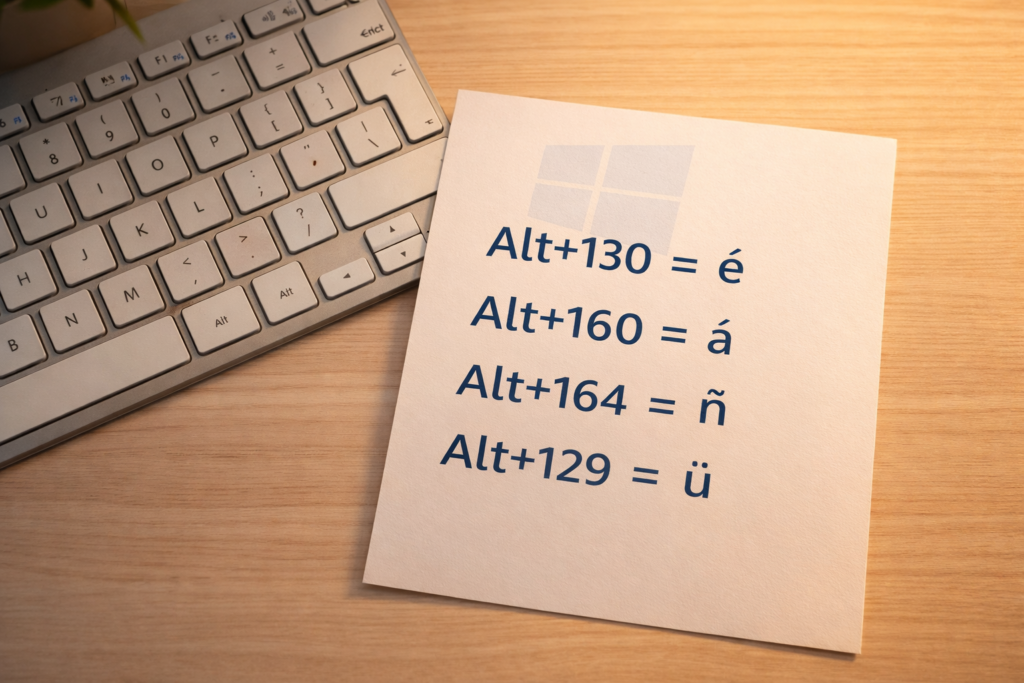
- Try four-digit codes – Use the corresponding four-digit code, including its leading zero (for example, use Alt + 0233 for é instead of the legacy Alt + 130)
- Check your keyboard – Some keyboards have different layouts
- Laptop users – Use the manufacturer’s Fn shortcut only if your laptop has an embedded numeric keypad
If your laptop has an embedded numeric keypad:
- Look for numbers printed on keys (usually J, K, L, U, I, O, etc.)
- Press and hold Fn + Alt
- Type the code using these embedded numbers
- Release both keys. If your laptop has no embedded keypad, use Character Map, the symbols panel, the US International keyboard or copy and paste instead.
Alternative Methods for Typing Accents on Windows
If Alt codes feel cumbersome, consider these alternatives:
Method 1: US International Keyboard. Enable the US International keyboard layout in Windows settings. This allows you to type accent marks by pressing the accent key followed by the letter.
Method 2: Character Map. Open the Character Map app, select your character, and copy and paste it.
Method 3: Windows Key + Period. Press Windows key + period (.) to open the emoji and symbols panel, which includes accented characters.
Method 4: AutoCorrect. In Microsoft Word or another application that supports custom replacements, create an AutoCorrect rule such as “e'” → “é”.
Quick Reference: Most Common Alt Codes
Keep this short list handy for the most frequently used accented characters:
- é = Alt + 0233
- á = Alt + 0225
- ñ = Alt + 0241
- ü = Alt + 0252
- ç = Alt + 0231
- à = Alt + 0224
- è = Alt + 0232
Printing This Guide
This guide works great as a printed reference sheet. Simply print this page and keep it near your computer for quick access to Alt codes whenever you need them. Check out our printable Alt Codes Quick Reference Guide as well.
Conclusion
Mastering Alt codes takes a bit of practice, but once you memorize the codes for your most-used characters, typing accents becomes second nature. Whether you’re writing in Spanish, French, German, or another language, these four-digit codes provide a dependable method in many Windows applications when you have a numeric keypad and Num Lock enabled.
Bookmark this page if you would like to keep the most commonly used codes within easy reach.