Modern French began with Latin, but that is only the beginning of the story. The Latin spoken in ancient Gaul encountered a Celtic language already rooted there. Then Germanic Franks arrived and left their own vocabulary and sounds behind. Medieval France broke into a patchwork of regional languages and dialects, while kings gradually favored the French used around their courts and administration.
Later, printers, grammarians, and scholars tried to bring order to an increasingly complicated spelling system. Eventually, the state joined in. The result was French: unmistakably a Romance language, but one whose pronunciation, vocabulary, and spelling traveled much farther from Latin than Spanish or Italian did.
That history also helps explain something immediately visible on the page. French uses an impressive collection of diacritics:
é, è, ê, ë, à, â, î, ï, ô, ù, û, ü, ç
They are not remnants of some ready-made Latin accent system. Most developed much later, as writers and printers tried to solve problems created by centuries of sound change. French had changed, and its spelling needed ways to keep up.
1. Latin Arrives in Gaul
Before there was France, there was Gaul.
Much of what is now France was inhabited by Celtic-speaking peoples whom the Romans collectively called the Gauls. Their language, Gaulish, belonged to the Celtic family—the same broad branch that eventually produced languages such as Irish and Welsh, although Breton itself came to France later from Britain.
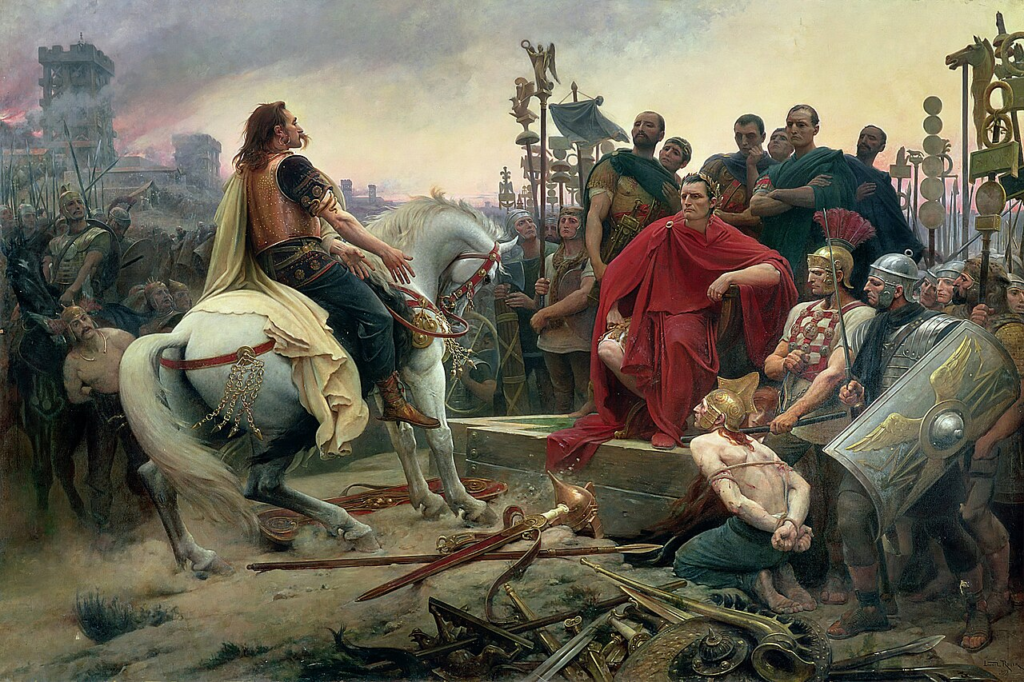
Rome’s conquest of Gaul accelerated dramatically under Julius Caesar between 58 and 50 BC. Conquest brought Latin.
As elsewhere in the Roman world, the language that spread through daily life was not simply the polished literary Latin associated with Cicero and Virgil. Soldiers, merchants, administrators, farmers, and settlers spoke changing varieties of everyday Latin. Gaul gradually became bilingual, then increasingly Latin-speaking.
Gaulish did not disappear immediately. Languages rarely do. Generations of speakers continued using it while Latin gained prestige in government, trade, education, and urban life. Eventually, Latin became dominant, but Gaulish left fingerprints behind.
French contains a relatively small number of words ultimately associated with Gaulish, including chêne (“oak”) and alouette (“lark”). Gaulish also survives in many place names. Its influence was modest compared with what came later, but before French was Latin transformed by the Franks, it was Latin spoken by people whose parents and grandparents had spoken something else.

2. Then Came the Franks
The Western Roman Empire weakened during the fifth century. Germanic peoples moved into former Roman territory, and one group became especially important in northern Gaul: the Franks.
Their name would eventually give France its name.
But something interesting happened linguistically. The Franks conquered a largely Romance-speaking population, yet they did not replace that population’s language with their own. Instead, they gradually adopted it.
Latin—or, more accurately by then, the developing Gallo-Romance language of the population—won again. This time, however, the incoming language left a much deeper imprint.
Frankish contributed words that remain ordinary French today:
guerre — war
bleu — blue
jardin — garden
The Germanic influence was particularly noticeable in vocabulary connected with warfare, social organization, rural life, and everyday objects. It also affected French pronunciation and sound development, although linguists are cautious about assigning any single feature of modern French to Frankish influence alone. French prosody changed over many centuries, and the modern language’s stress patterns cannot simply be explained as a Germanic inheritance.
Still, the Frankish layer helps explain why French can feel so different from its Romance cousins. Spanish, Italian, Portuguese, and French all came from Latin, but French grew up in unusually close contact with Germanic speakers. The influence arrived early enough to become part of the language while French itself was still taking shape.
3. When Does Latin Become French?
There is no morning on which people in Gaul woke up speaking French instead of Latin.
Languages do not change that way. One generation understands the previous generation perfectly well. Then another does the same. Pronunciations shift a little. Endings disappear. Words change shape.
After several centuries, the accumulated changes become enormous.
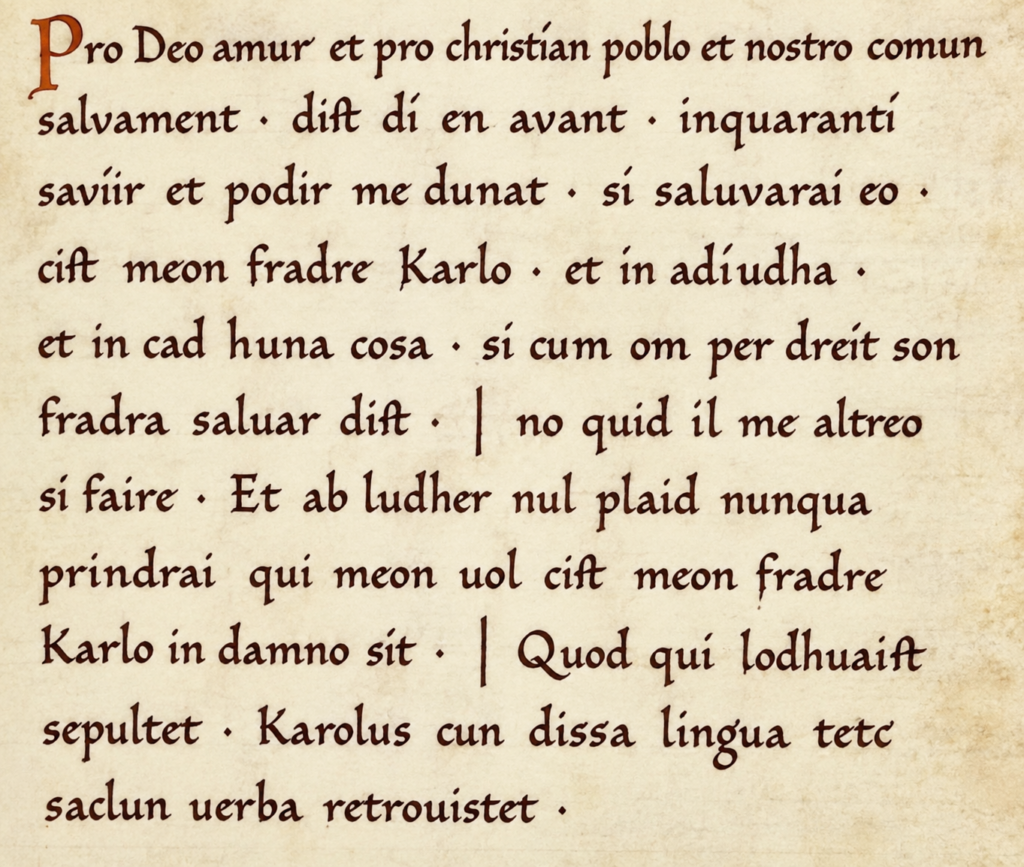
By the ninth century, the spoken Romance of northern Gaul had moved so far from classical Latin that Latin could no longer serve as an ordinary spoken language for much of the population. Then, in 842, we get an extraordinary glimpse of the change.
Two grandsons of Charlemagne, Charles the Bald and Louis the German, formed an alliance against their brother Lothair. Their agreement became known as the Oaths of Strasbourg. Because the soldiers needed to understand what their leaders were promising, parts of the oath were recorded not in conventional Latin, but in the Romance vernacular spoken by one army and the Germanic language spoken by the other.
The Romance portion does not look like modern French, and it is not quite what we normally mean by Old French either. But it clearly is not ordinary Latin anymore.
Something new had emerged.
4. There Wasn’t One French
Even then, there was no single French language stretching uniformly across the territory of modern France. There were regional Romance varieties.
In the north, people spoke varieties that linguists group as the langues d’oïl. In the south were the langues d’oc, including the varieties we now associate with Occitan.
The names themselves come from different words for “yes.” In the north: oïl, which eventually became modern oui. In the south: oc.
That tiny difference became a convenient way to describe two broad linguistic zones, but each zone contained still more variation. Northern France included Norman, Picard, Champenois, Burgundian, and other varieties. Southern France had its own rich linguistic landscape.
This matters because the familiar story that “the Paris dialect became French” is a little too neat. Paris certainly became enormously important, but standard French did not simply descend from one pure medieval dialect called Francien while all the others stood aside.
As royal, commercial, literary, and administrative networks expanded, a more widely usable form of northern French developed. Paris and the Île-de-France sat at the political center of that process, but speakers and writers drew from a broader linguistic world.
French was beginning to standardize, but slowly.
5. The King Chooses French
Latin still had prestige. For centuries it remained the language of the Church, scholarship, law, and much official writing.
French, however, was gaining ground. Royal administration increasingly used it. Literature flourished in the vernacular. Writers demonstrated that French could carry epic poetry, romance, history, argument, and law.
Then came 1539.
King Francis I issued the Ordinance of Villers-Cotterêts, a sweeping legal measure best remembered today for two articles dealing with language.
The problem was practical. Legal documents written in Latin could be difficult to understand and interpret. The ordinance required judicial and administrative acts to be written in “langage maternel françois” rather than Latin.
That did not instantly make every person in France a French speaker. Far from it. Millions of people continued speaking regional languages and dialects for centuries. Occitan, Breton, Basque, Alsatian, Corsican, Flemish, and numerous regional Romance varieties did not vanish because a king signed a document.
But the ordinance strengthened French where power mattered. Courts used it. Administrators used it. The monarchy used it.
Language and state were becoming increasingly intertwined.
6. Meanwhile, French Spelling Had a Problem
By the Renaissance, spoken French had changed enormously, but its spelling carried centuries of history.
That created tension.
Some letters represented sounds that had disappeared. Some spellings preserved connections with Latin. Printers inherited competing conventions. Writers did not always agree on how words should look. And French pronunciation had moved farther from the spelling than Spanish pronunciation generally had.
So writers, printers, and grammarians began experimenting with ways to make distinctions clearer.
Enter the accent marks.
They did not arrive all at once. They accumulated.
The acute accent: é
The acute accent became especially useful on e. Compare é with an unaccented e. The accent helped show that the vowel should not be treated like the unstressed or silent e that had become so common in French.
Words such as:
école
été
café
could now carry information about pronunciation directly in their spelling.
The grave accent: è, à, ù
The grave accent took on several jobs. On è, it often signals a more open vowel:
père
très
On à and ù, its job can be grammatical rather than phonetic:
a — has
à — to, at
ou — or
où — where
The letters are almost the same. The accent tells you which word you are looking at.
The circumflex: â, ê, î, ô, û
Then there is French’s most visually distinctive accent:
ˆ
The little hat.
In many words, the circumflex preserves the memory of a letter that disappeared from an older spelling—often an s. That is why English can sometimes reveal the history:
French forêt — English forest
French hôpital — English hospital
The two languages preserve related forms at different moments, and English sometimes kept a consonant French later lost.
But the “missing s” explanation is only part of the story. Not every French circumflex represents a vanished s, and the mark can also help distinguish words or reflect older pronunciation differences.
French spelling history rarely gives us one rule without exceptions.
The diaeresis: ë, ï, ü
The tréma, or diaeresis, solves another problem. It tells you that neighboring vowels should not be read in the way you might normally expect:
Noël
naïve
The dots look exactly like a German umlaut, but they are not doing the same job. German umlauts change vowel quality. The French tréma helps tell the reader how adjacent vowels are divided or pronounced.
The cedilla: ç
Finally, there is ç.
Normally, French c before a, o, or u would have a hard sound. The cedilla changes the instruction:
garçon
français
Read that c like s.
French had gradually assembled a small toolkit. One mark helped with vowel quality. Another separated words. Another preserved spelling history. Another told vowels to stay apart. Another changed a consonant.
The system looks complicated because it grew out of several different problems.

7. The Académie française Arrives
By the seventeenth century, language had become a matter of national prestige, and Cardinal Richelieu understood that.
In 1635, under Louis XIII, the Académie française received official status. Its mission was remarkably ambitious: to establish reliable rules for French and make the language, in the words of its founding statutes, pure, eloquent, and capable of treating the arts and sciences.
That sounds very French.
But the Académie did not invent standard French or create its accents from scratch. Writers, printers, grammarians, courts, and ordinary speakers had already been shaping the language for centuries. What the Académie supplied was institutional authority.
Its great project was a dictionary.
The first Dictionnaire de l’Académie française appeared in 1694. Even then, French spelling was not fully settled. The Academy’s own history describes the first dictionary as a compromise between older, etymological spellings and reformers who wanted writing to follow pronunciation more closely.
The accents were still being regularized. Later editions went further. Letters that were no longer pronounced disappeared from some words. In certain cases, an old s was removed and replaced by a circumflex.
Spelling moved gradually toward forms modern readers would recognize. Not perfectly, not consistently, and certainly not quickly.
French orthography became standardized through centuries of argument.
The argument has never entirely stopped.
8. Why French Spelling Still Looks So Historical
This helps explain one of the great frustrations of learning French.
Why write letters that are no longer pronounced? Why distinguish é, è, ê, and plain e? Why does a word such as beaucoup contain more letters than its pronunciation seems willing to acknowledge?
Because French spelling is doing more than recording sound. It is also recording history.
A written word may preserve an old consonant, reveal a relationship to another word, maintain a grammatical distinction, or reflect a pronunciation that has since changed. French spelling is therefore less phonetic than Spanish, but it is not simply irrational.
Think of it as archaeological.
The modern pronunciation sits on top, while older stages of the language remain buried in the spelling underneath. Accent marks sometimes act like little excavation signs pointing toward them.

9. French Leaves France
By the time French spelling was becoming increasingly standardized, the language itself was traveling.
French settlement carried it to North America—to what became Quebec, Acadia, Louisiana, and other communities. Colonial rule carried French through the Caribbean. Later French and Belgian imperial expansion spread it across large areas of West and Central Africa and into North Africa, the Indian Ocean, Southeast Asia, and the Pacific.
But languages never travel without changing.
French in Quebec developed its own vocabulary and pronunciation. So did Acadian French. So did varieties spoken in Africa and the Caribbean.
And in some colonial societies, contact among French, African languages, Indigenous languages, and other European languages produced something more than a regional form of French.
It produced new languages.
Haitian Creole, for example, has much of its vocabulary from French but has its own grammar and linguistic history. It is not simply “incorrect French” or an unusually strong French dialect.
It is a language in its own right.
The same distinction matters elsewhere in the French-speaking world. Colonization spread French, and communities then made it their own.
10. The Center of French Is Moving
For centuries, it was easy to imagine French as a language radiating outward from Paris.
That picture is increasingly inadequate.
France remains enormously important to the language, of course. But much of French’s demographic future lies elsewhere—especially in Africa.
The majority of the world’s French speakers now live outside France, and Africa contains an increasingly large share of the global Francophone population. In many African countries, French exists alongside several other languages rather than replacing them.
A person may use one language at home, another in the neighborhood, French at school or work, and perhaps another in regional trade. So even the category “native French speaker” can become less useful than it first appears.
French may be a first language, a second language, a language of education, a national lingua franca, or several of those things at once.
The center of gravity is shifting, and as millions of speakers use French in new settings, they continue doing what speakers have always done: they change it.
The Long View
French began as Latin spoken in a Celtic land. Gaulish left a faint layer beneath it, and the Franks added a Germanic layer on top. Over centuries, spoken Latin changed so thoroughly that the people using it no longer understood classical Latin as their everyday language.
Regional Romance varieties flourished. Royal government gave one expanding form of northern French increasing power. The Renaissance brought printers and grammarians. The monarchy brought language policy. The Académie brought institutional codification. Colonialism carried French around the world.
And every stage left something behind.
That includes the accents.
The acute accent can tell you how to read an é. The grave can distinguish à from a or où from ou. The circumflex can preserve the ghost of a consonant that vanished centuries ago. The tréma can keep neighboring vowels apart. The cedilla can turn a hard c soft.
They may look like tiny marks floating above or beneath a letter, but they are carrying pieces of French history.
And French has a lot of history to carry.