Modern “world English” did not descend through one clean line. It was built in layers.
Each wave of conquest, migration, technology, and cultural influence left something behind: new words, new sounds, new spelling habits, even new ways of building sentences. The English spoken around the world today is the result of all those layers pressed together.
That history also helps explain one of English’s stranger features: despite borrowing heavily from languages that use accent marks, English itself uses almost none.
To understand how that happened, it helps to start at the bottom.
1. Germanic bedrock (450–1066 AD)
The foundation of English is Germanic.
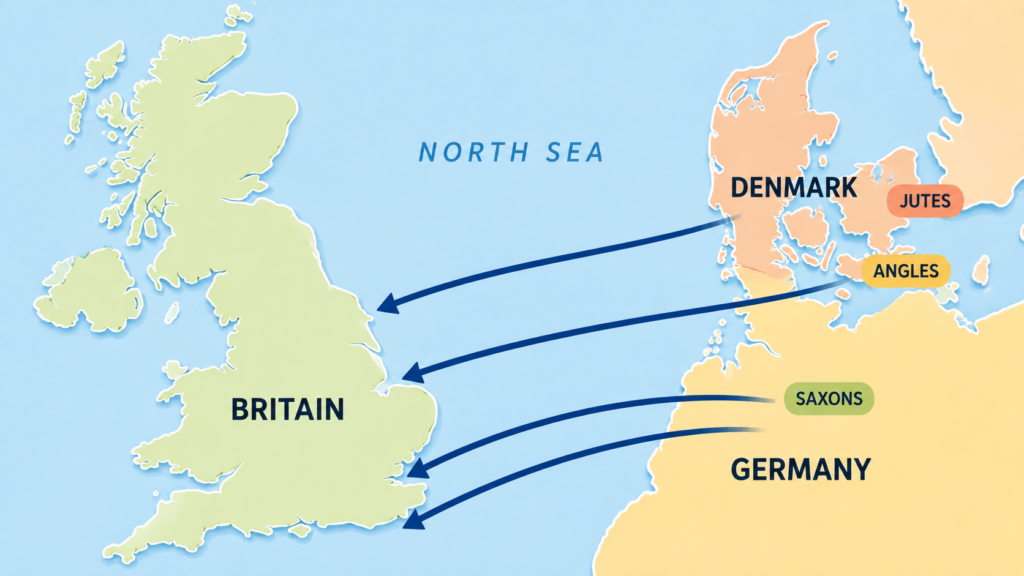
Beginning in the fifth century, Anglo-Saxon settlers arrived in Britain from areas that are now part of Germany, Denmark, and the Netherlands. Their languages gradually developed into what we call Old English.
Modern English speakers would have trouble understanding Old English if they heard it spoken. Yet many of the language’s most basic words are still recognizably descended from it. Words for everyday things — house, water, bread, child — are largely Germanic. So are many of our most common verbs, including eat, drink, sleep, and love. Even basic pronouns and grammatical building blocks have deep roots in this early layer.
In other words, French and Latin would later provide English with much of its elaborate vocabulary. But the skeleton remained Germanic.
Written English looked different too.
Before Christianization spread the Latin alphabet through England, Germanic peoples used runic writing. Later scribes adopted Latin letters but supplemented them with characters suited to English sounds. Old English manuscripts contain letters such as thorn (þ) and eth (ð) for the sounds we now write with th, wynn (ƿ) for a w sound, and ash (æ).
Modern English eventually abandoned all of them.
That is worth remembering when modern English seems reluctant to use accent marks or special characters. Earlier forms of English used them much more freely.
2. Old Norse infusion (8th–11th century)
Then came the Vikings.
Beginning in the eighth century, Scandinavian raiders attacked Britain. Raiding gradually became settlement, particularly in the large region of northern and eastern England that came under Danish influence and became known as the Danelaw.
The newcomers spoke Old Norse, another Germanic language. Old English and Old Norse were related closely enough that their speakers could recognize parts of one another’s speech — but not closely enough for communication to be effortless.
The two languages began rubbing against each other.
English absorbed ordinary Norse words such as sky, window, egg, husband, and law. Even the pronouns they, them, and their entered English from Norse, replacing older English forms.
The contact may also have helped simplify English grammar.
Old English, like modern German, relied heavily on inflections: endings attached to nouns, adjectives, and other words to show their grammatical role. But when speakers of two related languages were trying to understand one another, those complicated endings could become obstacles rather than aids. Word order and simpler forms did more of the work.
Over time, many inflections disappeared.
The result was an English that remained Germanic but was becoming grammatically leaner.
3. The Norman turning point (1066)
Then, in 1066, everything changed.
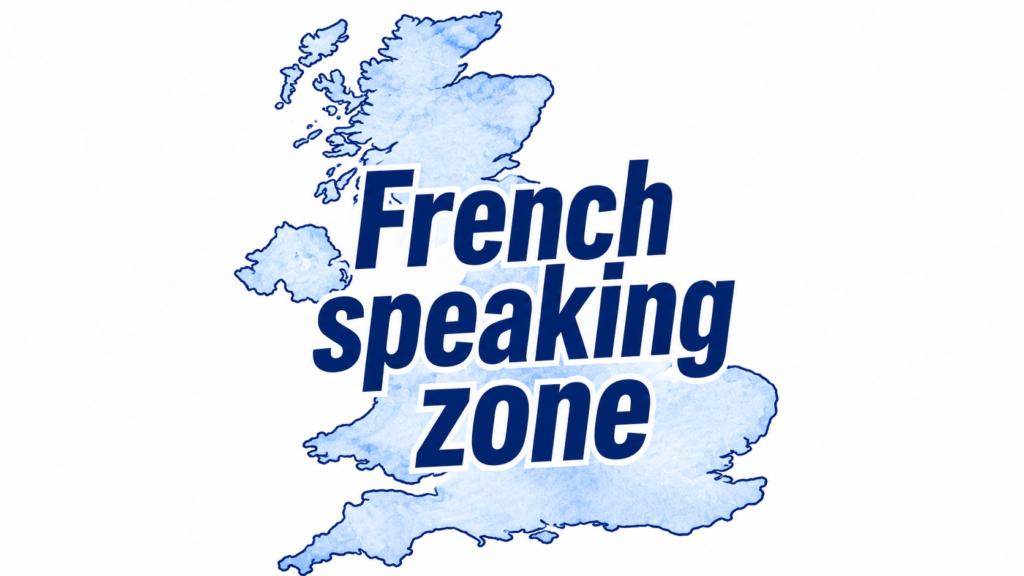
William the Conqueror defeated Harold Godwinson at the Battle of Hastings and established a Norman ruling class in England. The Normans spoke varieties of French.
For roughly the next three centuries, England effectively lived with languages divided by social function. French dominated the royal court, aristocracy, law, government, and prestige culture. Latin remained important in the Church and scholarship.
English, meanwhile, continued to be spoken by most ordinary people.
The languages did not remain separate forever. Inevitably, they mixed.
And English emerged from that encounter with one of its most distinctive characteristics: enormous sets of near-synonyms drawn from different linguistic layers.
Consider animals and food.
The English-speaking farmer tended the cow, a Germanic word. The French-speaking nobleman ate beef, from French. The same pattern appears with calf and veal, sheep and mutton, pig and pork.
The social divide became fossilized in the vocabulary.
The same thing happened more broadly. English often offers a short Germanic word and a more formal French or Latin alternative:
ask and inquire
help and assist
begin and commence
house and domicile
The meanings are not always identical, but the pattern remains powerful. It helps explain why English can shift registers so easily. A writer can sound plain and direct with Germanic vocabulary, then become formal or technical simply by reaching into the French and Latin layers.
This double vocabulary is one of the defining features of modern English.
4. Standardization and the printing press (1400s–1600s)
For centuries, English spelling was remarkably flexible.
A word might be written differently from one town to another — or even differently by the same writer on the same page. There was no national spelling authority telling everyone which version was correct.
Gradually, that began to change.
By the late Middle Ages, the written English used by government clerks in London — often called Chancery English — was gaining prestige. Because official documents traveled throughout the country, London-based spelling and grammatical conventions acquired influence far beyond the capital.
Then technology intervened.
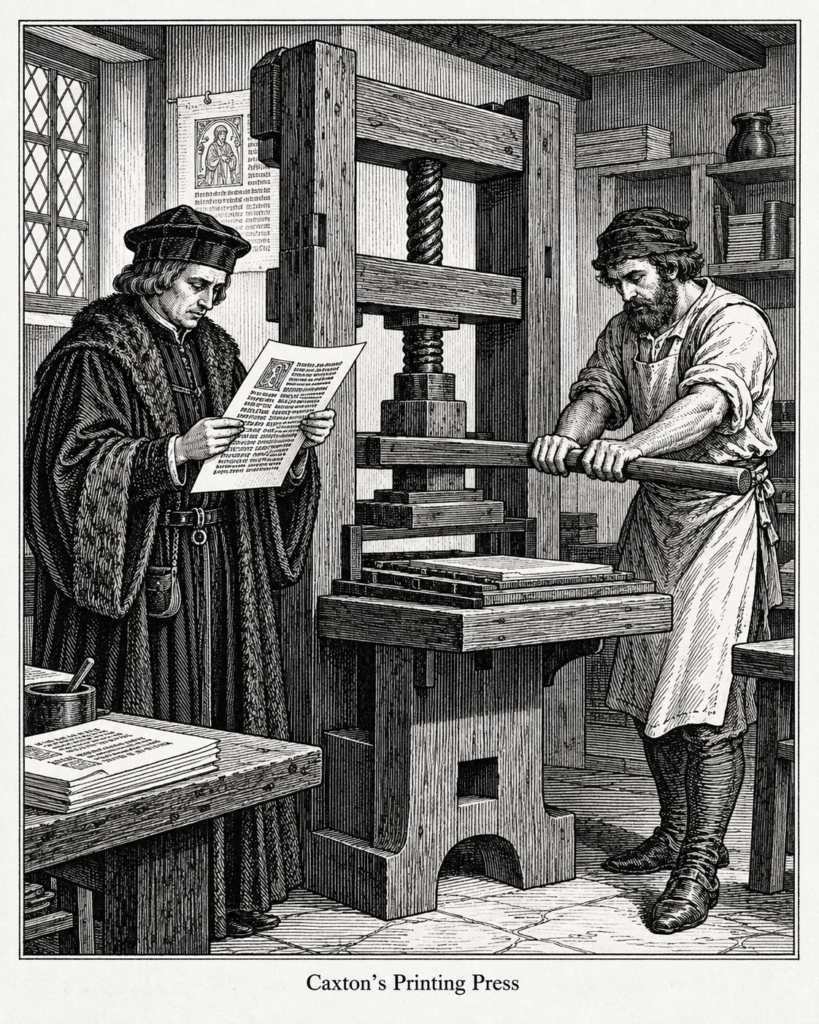
William Caxton introduced the printing press to England in 1476. Printers had a practical reason to prefer consistent spellings: books were much easier to produce when compositors did not have to choose among endless local variants.
Spelling began to settle down.
Unfortunately, pronunciation did not.
At roughly the same time, English was passing through the Great Vowel Shift, a centuries-long transformation in the pronunciation of many long vowels. Words changed dramatically in speech while their printed spellings became increasingly fixed.
English spelling, in effect, took a photograph while the language was still moving.
That is one reason modern English spelling can seem so irrational. The letters often preserve clues to an older pronunciation rather than describing the sounds we make today.
It also raises an interesting question.
Why didn’t English solve the problem by adopting accent marks?
Other European languages use diacritics to distinguish vowel qualities, stress, or pronunciation. English certainly had access to those marks through French and other languages. Yet they never became part of ordinary native spelling.
English instead tolerated ambiguity — and accumulated rules, exceptions, and historical spellings.
5. Empire and global spread (1600s–1900s)
English might have remained principally the language of Britain.
History had other plans.
Beginning in the seventeenth century, British settlement and colonization carried English across the Atlantic and eventually around the world. It took root in North America and the Caribbean, then spread through imperial expansion into South Asia, Africa, Australia, New Zealand, and the Pacific.
But languages do not travel unchanged.
Wherever English went, it encountered new foods, landscapes, peoples, technologies, and customs. Speakers needed words for them. Sometimes English invented those words. More often, it borrowed them.
English in North America absorbed vocabulary from Indigenous languages and from Dutch, Spanish, French, and African languages. In India it picked up words such as bungalow, shampoo, and pajamas. Other varieties developed their own vocabulary, rhythms, pronunciations, and grammatical habits.
There was no longer one English.
There were Englishes.
British imperial power provided much of the common framework, but local communities reshaped the language for their own purposes. That process continues today.
So when people speak of “world English,” they are not really describing a single uniform variety. Nigerian English, Indian English, Singapore English, Australian English, British English, and American English all belong to the same broad linguistic family while remaining recognizably distinct.
What is sometimes called “standard global English” is closer to a shared international register: a relatively neutral form influenced heavily by educated British and American usage and favored in business, education, media, aviation, diplomacy, and international communication.
Useful, certainly.
But hardly monolithic.

6. 20th-century American dominance
By the early twentieth century, Britain had carried English around the world.
After World War II, the United States increasingly determined which variety the world heard most often.
The reasons were not primarily linguistic. They were economic and cultural.
The United States emerged from the war with extraordinary industrial, financial, military, and political power. American companies operated internationally. American universities attracted students from abroad. American popular culture traveled even farther.
Hollywood supplied the voices.
Radio and television amplified them.
Later came computers, software, and the internet.
Much of the early digital world developed in an American technological environment, giving American vocabulary and spelling still more international visibility. Words such as movie, apartment, truck, and vacation became familiar even to people whose schools taught British forms such as film, flat, lorry, and holiday.
The center of gravity had shifted.
Today, many people learning English as a second language encounter American English constantly through movies, music, social media, software, streaming video, and the web. In that sense, American English has become something close to the default international register.
But it has not replaced the other varieties.
English is now too widely distributed for any country to own it. Britain supplied the language’s earliest global network. The United States greatly expanded its modern cultural reach. But hundreds of millions of speakers elsewhere continue to reshape it every day.
That may be the final layer — at least for now.
English began as a collection of Germanic dialects spoken on the edge of Europe. Vikings simplified and enlarged it. Norman conquest filled it with French. Printing stabilized it while its pronunciation was still changing. Empire carried it across the world. American media and technology gave one variety unprecedented reach.
And now the process has escaped any single center.
World English is not one lineage.
It is the accumulated record of everyone who has spoken it.