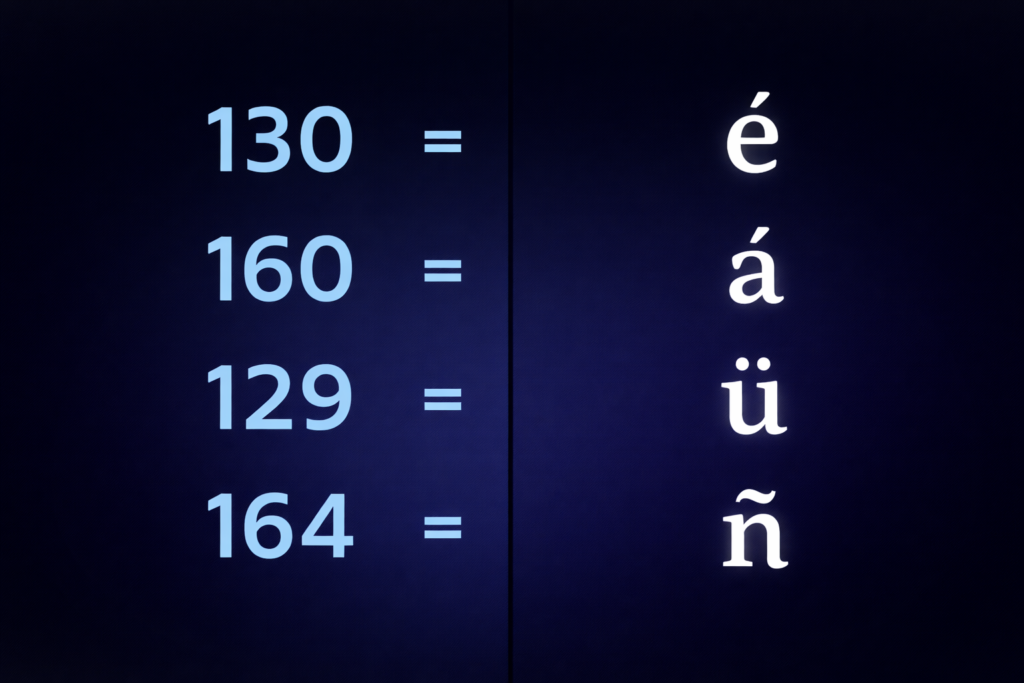
Looking for ASCII codes to type accented characters? While technically these are called Alt codes or extended ASCII codes, this complete reference gives you the numeric codes you need to type é, á, ñ, ü, and hundreds of other accented characters on Windows.
Whether you’re typing in Spanish, French, German, Portuguese, Italian, or any other language with accents, this guide provides the exact codes and instructions you need.
Understanding ASCII vs. Alt Codes
Let’s clear up the terminology first, since many people search for “ASCII codes” when they actually need “Alt codes.”
Standard ASCII:
The original ASCII (American Standard Code for Information Interchange) includes only 128 characters: English letters, numbers, and basic punctuation. It doesn’t include accented characters.
Extended ASCII:
Extended ASCII adds another 128 characters (codes 128-255), including accented letters, special symbols, and graphic characters.
Alt Codes:
On Windows, you access these extended ASCII characters by holding Alt and typing a numeric code. This is why they’re called “Alt codes.”
What you’re really looking for:
When you search for “ASCII codes for accents,” you’re actually looking for Alt codes. This guide gives you exactly what you need, regardless of what it’s technically called.
How to Use ASCII/Alt Codes on Windows
The process is simple:
- Position your cursor where you want the character
- Hold down the Alt key
- Type the numeric code using your number pad (on the right side of your keyboard)
- Release the Alt key
- The accented character appears!
Critical requirement: You must use the numeric keypad, not the numbers above the letter keys.
Laptop users: If your laptop doesn’t have a dedicated number pad, look for an embedded number pad (numbers on letter keys, usually blue or gray). Press Fn + Alt, then type the code using these keys.
For a quick printable reference of all codes, see our Alt Codes Quick Reference Chart. For special characters beyond accents, check our Special Characters on Windows guide.
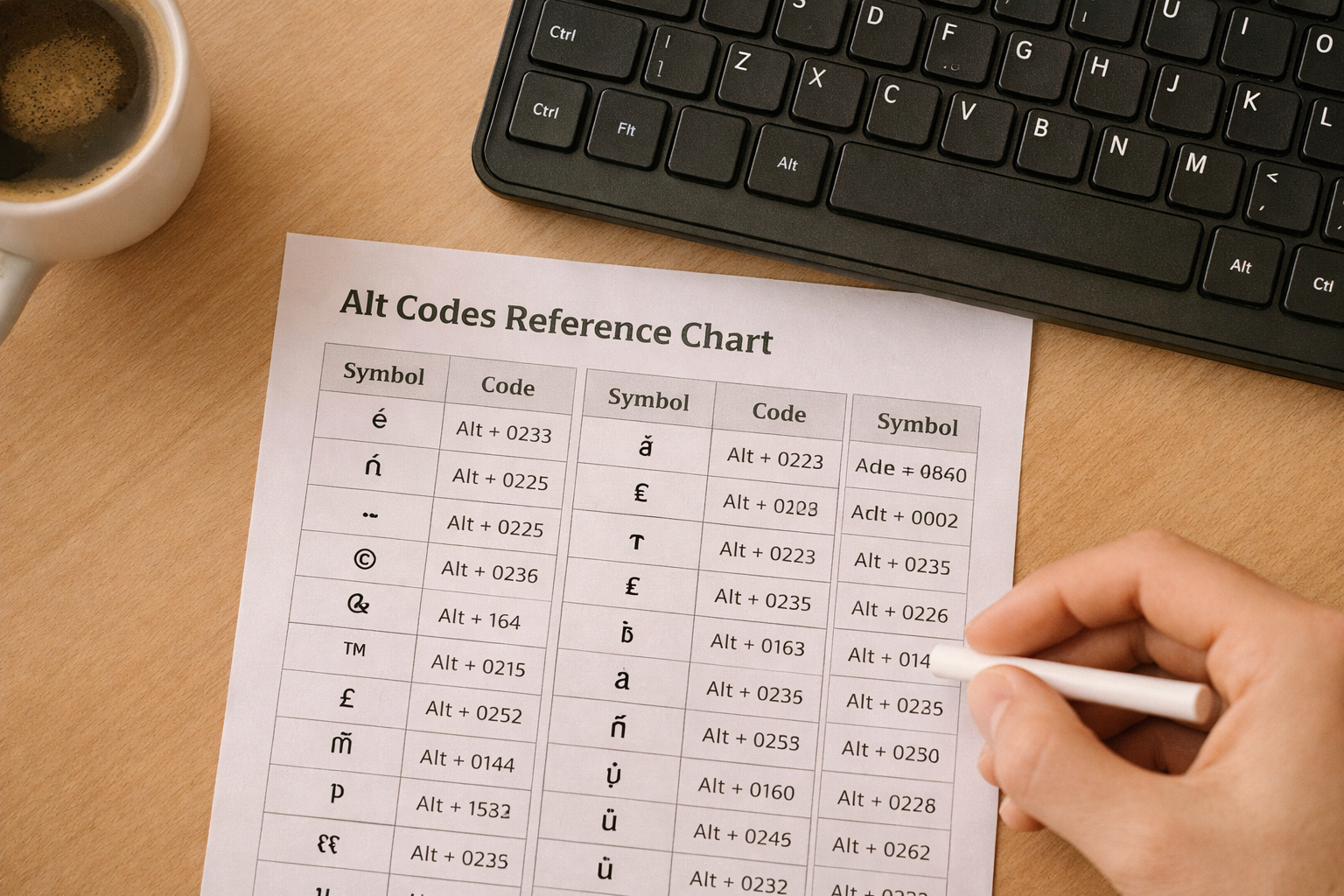
Complete ASCII Codes for Accented Vowels
These are the most frequently used accented characters across all languages:
Lowercase Vowels
A with accents:
- á (acute) = Alt + 160
- à (grave) = Alt + 133
- â (circumflex) = Alt + 131
- ã (tilde) = Alt + 0227
- ä (umlaut) = Alt + 132
E with accents:
- é (acute) = Alt + 130
- è (grave) = Alt + 138
- ê (circumflex) = Alt + 136
- ë (umlaut) = Alt + 137
I with accents:
- í (acute) = Alt + 161
- ì (grave) = Alt + 141
- î (circumflex) = Alt + 140
- ï (umlaut) = Alt + 139
O with accents:
- ó (acute) = Alt + 162
- ò (grave) = Alt + 149
- ô (circumflex) = Alt + 147
- õ (tilde) = Alt + 0245
- ö (umlaut) = Alt + 148
U with accents:
- ú (acute) = Alt + 163
- ù (grave) = Alt + 151
- û (circumflex) = Alt + 150
- ü (umlaut) = Alt + 129
Uppercase Vowels
A with accents:
- Á = Alt + 0193
- À = Alt + 0192
- Â = Alt + 0194
- Ã = Alt + 0195
- Ä = Alt + 142
E with accents:
- É = Alt + 144
- È = Alt + 0200
- Ê = Alt + 0202
- Ë = Alt + 0203
I with accents:
- Í = Alt + 0205
- Ì = Alt + 0204
- Î = Alt + 0206
- Ï = Alt + 0207
O with accents:
- Ó = Alt + 0211
- Ò = Alt + 0210
- Ô = Alt + 0212
- Õ = Alt + 0213
- Ö = Alt + 153
U with accents:
- Ú = Alt + 0218
- Ù = Alt + 0217
- Û = Alt + 0219
- Ü = Alt + 154
ASCII Codes by Language
Spanish ASCII Codes
Essential characters for Spanish:
| Character | ASCII/Alt Code | Description |
|---|---|---|
| á | Alt + 160 | a acute |
| é | Alt + 130 | e acute |
| í | Alt + 161 | i acute |
| ó | Alt + 162 | o acute |
| ú | Alt + 163 | u acute |
| ñ | Alt + 164 | n with tilde |
| ü | Alt + 129 | u with umlaut |
| Á | Alt + 0193 | A acute |
| É | Alt + 144 | E acute |
| Í | Alt + 0205 | I acute |
| Ó | Alt + 0211 | O acute |
| Ú | Alt + 0218 | U acute |
| Ñ | Alt + 165 | N with tilde |
| Ü | Alt + 154 | U with umlaut |
| ¿ | Alt + 168 | inverted question |
| ¡ | Alt + 173 | inverted exclamation |
Common Spanish words:
- España (Spain) – uses ñ
- José (Joseph) – uses é
- más (more) – uses á
- año (year) – uses ñ
- mamá (mom) – uses á
For more Spanish-specific guidance, see our Spanish Accents Guide.
French ASCII Codes
French uses multiple accent types:
Acute accent (´):
- é = Alt + 130
- É = Alt + 144
Grave accent (`):
- à = Alt + 133
- è = Alt + 138
- ù = Alt + 151
- À = Alt + 0192
- È = Alt + 0200
- Ù = Alt + 0217
Circumflex (^):
- â = Alt + 131
- ê = Alt + 136
- î = Alt + 140
- ô = Alt + 147
- û = Alt + 150
- Â = Alt + 0194
- Ê = Alt + 0202
- Î = Alt + 0206
- Ô = Alt + 0212
- Û = Alt + 0219
Cedilla & Umlaut:
- ç = Alt + 135
- Ç = Alt + 128
- ë = Alt + 137
- ï = Alt + 139
- ü = Alt + 129
Ligatures:
- æ = Alt + 145
- œ = Alt + 0156
Common French words:
- café (coffee) – uses é
- être (to be) – uses ê
- français (French) – uses ç
- où (where) – uses ù
For comprehensive French guidance, see our French Accents Guide.
German ASCII Codes
German uses umlauts and the eszett:
| Character | ASCII/Alt Code | Description |
|---|---|---|
| ä | Alt + 132 | a with umlaut |
| ö | Alt + 148 | o with umlaut |
| ü | Alt + 129 | u with umlaut |
| Ä | Alt + 142 | A with umlaut |
| Ö | Alt + 153 | O with umlaut |
| Ü | Alt + 154 | U with umlaut |
| ß | Alt + 225 | sharp s (eszett) |
Common German words:
- über (over) – uses ü
- schön (beautiful) – uses ö
- Käse (cheese) – uses ä
- Straße (street) – uses ß
For detailed German information, see our German Accents Guide.
Portuguese ASCII Codes
Portuguese adds tildes to its accents:
Acute accents:
- á = Alt + 160, é = Alt + 130, í = Alt + 161, ó = Alt + 162, ú = Alt + 163
Grave accents:
- à = Alt + 133
Circumflex:
- â = Alt + 131, ê = Alt + 136, ô = Alt + 147
Tilde (distinctive to Portuguese):
- ã = Alt + 0227
- õ = Alt + 0245
- Ã = Alt + 0195
- Õ = Alt + 0213
Cedilla:
- ç = Alt + 135
- Ç = Alt + 128
Common Portuguese words:
- não (no) – uses ã
- mão (hand) – uses ã
- põe (puts) – uses õ
- português (Portuguese) – uses ê
For more Portuguese details, see our Portuguese Accents Guide.
Italian ASCII Codes
Italian primarily uses grave and acute accents:
Grave accents:
- à = Alt + 133, è = Alt + 138, ì = Alt + 141, ò = Alt + 149, ù = Alt + 151
Acute accent:
- é = Alt + 130
Common Italian words:
- città (city) – uses à
- caffè (coffee) – uses è
- perché (why/because) – uses é
- più (more) – uses ù
For complete Italian coverage, see our Italian Accents Guide.
If you’re working across multiple languages, you can see all accent shortcuts here:
👉 https://acuteaccents.com/how-to-type-accents
ASCII Code Tables
Extended ASCII Character Set (128-255)
This table shows the extended ASCII characters accessible via Alt codes:
Characters 128-159 (Control & Latin): Includes: Ç, ü, é, â, ä, à, å, ç, ê, ë, è, ï, î, ì, Ä, Å, É, æ, Æ, ô, ö, ò, û, ù, ÿ, Ö, Ü, ¢, £, ¥
Characters 160-191 (Latin Extended): Includes: á, í, ó, ú, ñ, Ñ, ª, º, ¿, ⌐, ¬, ½, ¼, ¡, «, »
Characters 192-255 (Box Drawing & Symbols): Includes box drawing characters, mathematical symbols, and Greek letters
Quick Reference by Accent Type
Acute accent (´) – sharp, rising: a=160, e=130, i=161, o=162, u=163
Grave accent (`) – falling: a=133, e=138, i=141, o=149, u=151
Circumflex (^) – hat: a=131, e=136, i=140, o=147, u=150
Tilde (~) – wavy: a=0227, n=164, o=0245
Umlaut (¨) – two dots: a=132, e=137, i=139, o=148, u=129, y=152
Cedilla (¸) – hook: c=135
Troubleshooting ASCII/Alt Codes
Codes Not Working
NumLock is off:
Press the NumLock key to activate your number pad.
Using wrong keys:
You must use the numeric keypad on the right, not the numbers above the letters.
Laptop without number pad:
Enable Fn key and look for embedded number pad (numbers printed on letter keys).
Try four-digit codes:
If three-digit codes fail (like Alt + 130), try the four-digit version (Alt + 0130).
Wrong Character Appears
Different font:
Some Alt codes produce different characters in different fonts.
Regional settings:
Your Windows language settings can affect Alt code behavior.
Keyboard layout:
Make sure you’re using US keyboard layout for standard Alt codes.
Character Displays as Box
Font doesn’t support character:
Switch to Arial Unicode MS, Segoe UI, or Cambria for maximum character support.
Encoding issue:
Save your document with UTF-8 encoding.
Alternative Methods
While ASCII/Alt codes work great on Windows, other methods might be easier for frequent use:
US International Keyboard
Enable this keyboard layout to type accents more naturally:
- ‘ + a = á
- ` + e = è
- ^ + o = ô
- ~ + n = ñ
- ” + u = ü
Character Map
Windows’ built-in Character Map provides visual access to all characters:
- Search for “Character Map”
- Browse or search for characters
- Copy and paste
Windows Emoji Picker
Press Windows + Period for quick symbol access (Windows 10/11).
For detailed instructions on all methods, see our Special Characters on Windows Guide.
ASCII Codes vs. Unicode
ASCII codes (0-127) are standardized worldwide
Extended ASCII (128-255) varies by code page
Unicode is the modern standard supporting all languages
When you use Alt codes on Windows, you’re technically using extended ASCII or Windows-1252 encoding. Modern applications use Unicode, but Alt codes still work because Windows converts them automatically.
For technical users:
- Alt + 0xxx uses Windows-1252 (ANSI) encoding
- Alt + xxx (without leading zero) uses Code Page 437 (original IBM PC)
- Both work in most applications, but 0xxx codes are more reliable
Platform-Specific Alternatives
ASCII/Alt codes are Windows-specific. For other platforms:
Mac users:
Use Option key combinations – see our Mac guide
iPhone/iPad:
Press and hold letters – see our iOS guide
Android:
Press and hold letters – see our Android guide
Chromebook:
Enable US International keyboard – see our Chromebook guide
Tips for Mastering ASCII Codes
Create a cheat sheet:
Print our Alt Codes Quick Reference Chart and keep it handy.
Memorize your most-used codes:
Focus on the 5-10 characters you type most frequently.
Use autocorrect:
Set up automatic replacements for words you type often.
Practice regularly:
The codes become automatic with repetition.
Keep NumLock on:
Save yourself constant toggling.
Common Uses for ASCII Codes
Academic writing:
Proper names, foreign phrases, citations
Business communications:
International correspondence, multilingual documents
Creative writing:
Authentic dialogue, foreign settings, character names
Technical documentation:
Product names, international standards, proper terminology
Personal correspondence:
Respectful spelling of names, foreign language practice
Conclusion
ASCII codes (more accurately called Alt codes) provide quick access to accented characters on Windows. Whether you need é for “café,” ñ for “mañana,” or ü for “über,” this reference gives you the exact codes you need.
Key takeaways:
- Hold Alt and type the numeric code on your number pad
- Three-digit codes (Alt + 130) or four-digit codes (Alt + 0130) both work
- NumLock must be enabled
- Different languages use different accent patterns
- Practice makes the codes automatic
Quick reference:
The five most common accented vowels are: é (130), á (160), í (161), ó (162), ú (163)
For a complete printable reference, bookmark our Alt Codes Quick Reference Chart.
Explore our other guides:
- Windows Alt Codes Complete List
- How to Type Special Characters
- Language-specific guides for Spanish, French, German, Portuguese, and Italian
👉 Need all accents in one place? See the full guide here: https://acuteaccents.com/how-to-type-accents